I used to think watching English YouTube was "studying." I'd put on a 20-minute video, nod along, maybe laugh at the right moments, and convince myself I was absorbing vocabulary like a sponge. Spoiler: I wasn't.
After years of this, my listening comprehension was decent — I could follow most conversations — but my active vocabulary hadn't grown much. I'd hear words like counterintuitive or leverage and vaguely recognize them, but I couldn't use them naturally in a sentence. Sound familiar?
The problem wasn't YouTube. The problem was how I was using it. Passive watching is great for listening practice, but it's terrible for vocabulary. Here's the method that actually changed things for me.
Why YouTube is (potentially) the best vocabulary tool you have
Every new word in a YouTube video comes wrapped in context — the speaker's tone, visuals, surrounding sentences. Your brain encodes all of that, not just the dictionary definition. Linguists call this incidental learning, and it leads to deeper retention than memorizing word lists. Add in the fact that you actually care about the content (low stress, high motivation), and you've got an ideal learning environment.
The problem with just watching
The catch: just watching — even with subtitles — doesn't force your brain to engage with individual words. When you read "The government has implemented a comprehensive overhaul of the tax system," you understand the sentence. But can you define overhaul on its own? Probably not, unless you've stopped and thought about it. That "stopping and thinking" is what turns passive exposure into active learning.
A practical system that doesn't kill the vibe
Here's what I do now. It's not complicated, and it takes maybe 30% more time than regular watching — but the vocabulary gains are night and day.
Step 1: Pick the right videos
Not all YouTube content is equally useful for vocabulary. You want videos where:
- You understand 80-90% of what's being said (not 100%, not 50%)
- The speaker talks at a natural pace (avoid deliberately slowed-down "easy English" channels if you're intermediate or above)
- There are English subtitles available (auto-generated is fine for most channels)
- You're genuinely interested in the topic
That 80-90% sweet spot is important. Linguist Stephen Krashen calls it i+1 — input that's just slightly above your current level. Too easy and there's nothing new. Too hard and you'll just feel frustrated.
A mistake I made early on: I started with TED Talks because they felt "educational." But TED speakers use rehearsed, formal vocabulary that rarely comes up in daily English. I switched to casual, unscripted channels and found the vocabulary was much more practical. Don't pick videos that feel like studying — pick videos your English-speaking friends would actually watch.
Step 2: Watch with subtitles and look up words — but be selective
Turn on English subtitles. When you hit a word you don't know, look it up. But here's the key: don't look up every unknown word. Pick 3-5 words per video, max.
Why the limit? Two reasons. First, if you pause every 30 seconds, you'll hate the experience and quit within a week. Second, trying to learn 30 words at once means you'll remember none of them. Your working memory has limits.
Prioritize words that:
- You've seen before but can't define (these are the lowest-hanging fruit)
- Seem useful beyond this specific video
- You could imagine using yourself
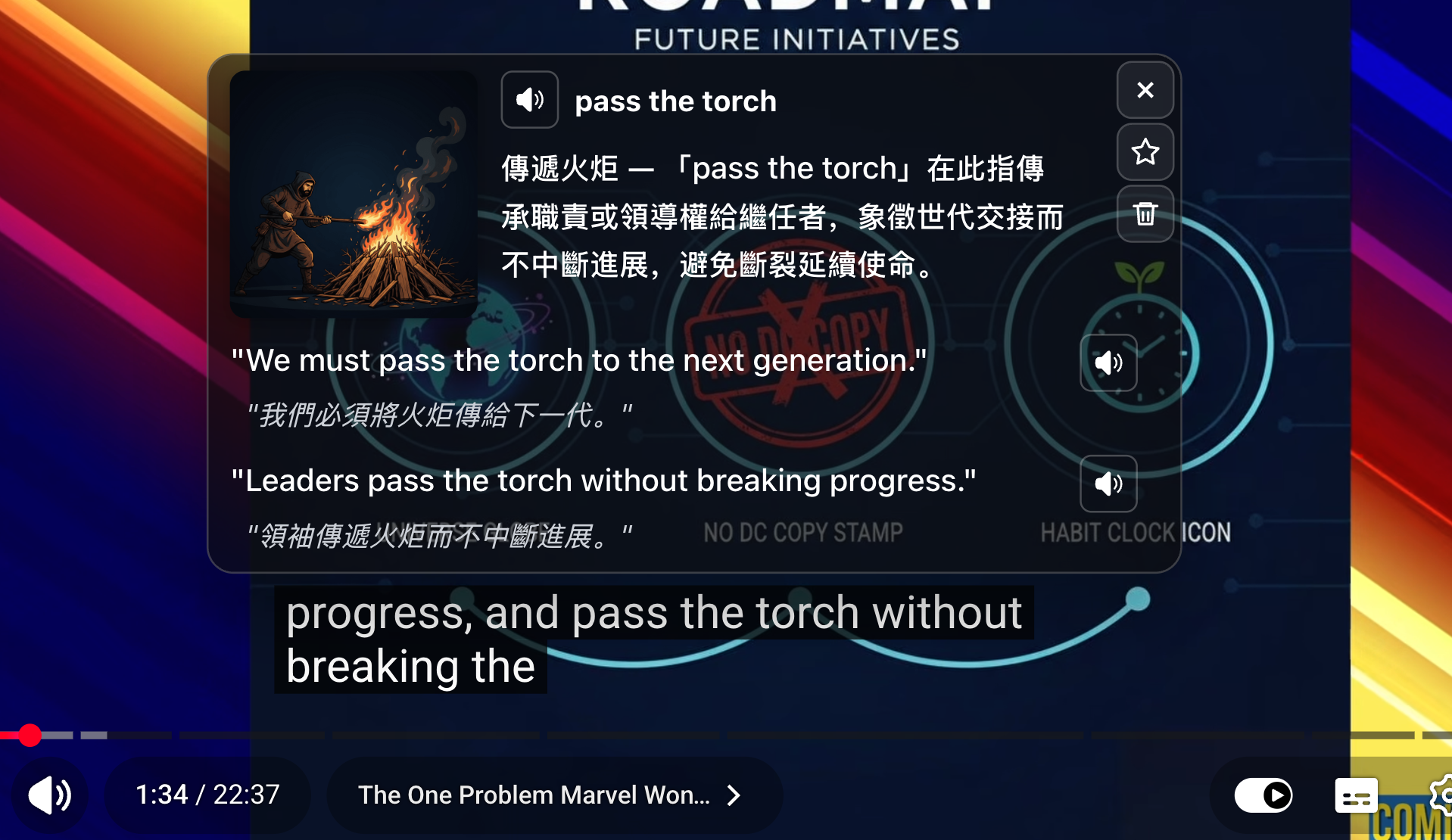
This is where having the right tool matters. Manually copying a word, switching tabs, reading a generic definition, and switching back is slow and disruptive. A browser extension that gives you an instant, in-context definition without leaving the page removes nearly all the friction. (Full disclosure: this is what VividRead does. But whatever tool you use, the principle is the same: reduce the cost of looking up a word to near zero.)
Step 3: Save the words you looked up
Looking up a word once gives you a momentary understanding. To actually remember it, you need to see it again. Save your 3-5 words somewhere with the sentence you heard them in and a short definition in your own words. Don't copy full dictionary entries — "overhaul = big change/redesign, used for systems" is way more useful than a 50-word Merriam-Webster definition.
Step 4: Review — but not the boring way
This is where most people drop off. You have a growing list of words, and reviewing them feels like homework. Here are two approaches that actually work:
Spaced repetition. This is the gold standard. Instead of reviewing all your words every day, a spaced repetition system shows you each word right before you're about to forget it. You review less, remember more. Apps like Anki work, but they're a pain to set up for vocabulary. Tools with built-in spaced repetition (like VividRead's Review feature) save you the setup time.
The "use it or lose it" approach. Try to use 2-3 of your new words in writing or conversation within 48 hours of learning them. Send a message using the word, write a sentence in a journal, or say it out loud in a voice memo. The act of producing the word — not just recognizing it — is what moves it from passive to active vocabulary.
Putting it all together
The routine in a nutshell:
- Pick a YouTube video you're genuinely interested in (80-90% comprehension level)
- Watch with English subtitles on — never your native language
- When you hit an unknown word, look it up right there — don't switch tabs
- Save 3-5 words per video with their context sentences
- Review your saved words every few days using spaced repetition
The hard part isn't the method — it's doing it consistently. But once it becomes a habit, you'll be surprised how quickly your vocabulary starts growing.
YouTube isn't a textbook, and that's exactly why it works.