Quick experiment. I'll give you two words to remember.
Word one: searing. It means extremely hot, burning.
Word two: torrential. It means flowing in large amounts, violently — and here's a picture of it:
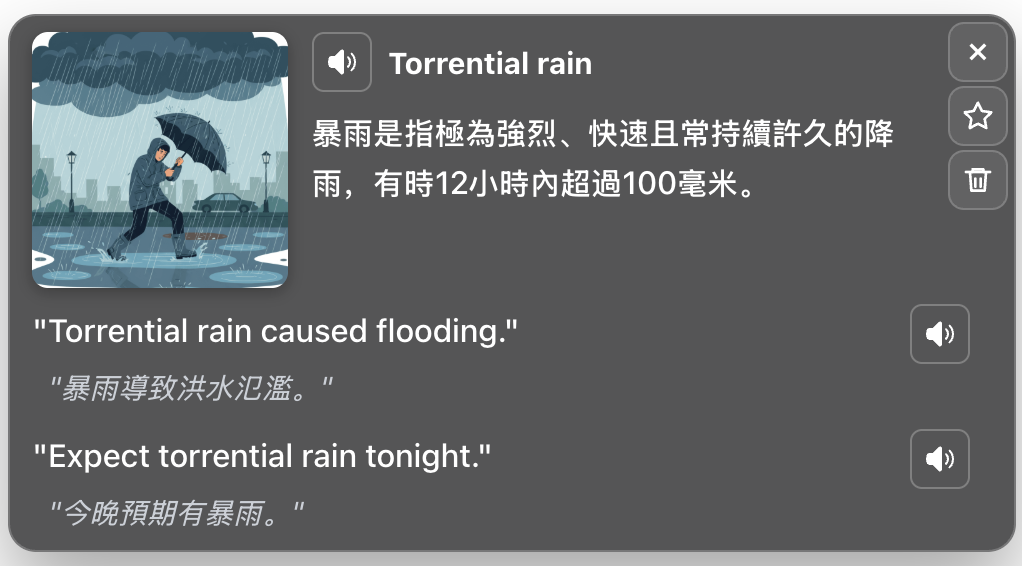
Come back to this article tomorrow and see which word you remember better. I'm willing to bet it's torrential. Both words are concrete and roughly the same difficulty — the only difference is one came with an image. Your brain now has two pathways to retrieve it: the text definition and the picture.
This isn't a trick. It's one of the most well-documented findings in cognitive psychology — and it's the reason we built a visual-aid feature into VividRead, even though it would have been way easier to just show text definitions.
Dual coding theory: two channels are better than one
In 1971, psychologist Allan Paivio proposed dual coding theory: our brains store information through two channels — verbal (words) and visual (images). Learn a word with a text definition, you get one memory trace. Add an image, you get two. If one fades, the other can still trigger recall. Paivio's research showed that words paired with images are remembered roughly twice as well as text alone — a finding replicated consistently over decades.
The picture superiority effect
In a well-known study by Lionel Standing (1973), participants were shown 10,000 images over five days. When tested, they identified which images they'd seen with 83% accuracy. Ten thousand images. Our visual memory is absurdly powerful. For vocabulary, this means: attach a vivid image to a word and you're giving your brain a "hook" to grab onto.
Why this matters specifically for English vocabulary
Abstract words become concrete. Words like resilience, arbitrary, nuance are hard to remember because there's nothing tangible to anchor them to. But a photo of a tree growing through cracked concrete can represent resilience in a way that the definition "the ability to recover quickly" simply can't.
Polysemous words get disambiguated. A visual aid pins down which meaning of bank or light you're learning. Image of a river bank vs. a financial institution — that distinction sticks.
Emotional connection. A picture of torrential rain doesn't just show you what the word means — it makes you feel the intensity. Neuroscientists call this the emotional enhancement of memory.
Not all visual aids are equal
Before you start Googling images for every new word, there's a catch: the quality and relevance of the image matters a lot.
A generic stock photo won't help much. If you look up the word serendipity and pair it with a random smiling person, that image doesn't encode any information about the word's meaning. It's just a picture next to a word — decorative, not functional.
Effective visual aids should be:
- Semantically relevant — the image should depict or evoke the word's meaning
- Specific to the context — if you learned scorching in a sentence about desert heat, the image should show a scorching desert, not just a generic sun icon
- Vivid and memorable — slightly unusual or striking images work better than bland ones (this is the bizarreness effect in memory research)
- Not too complex — you want the word-to-image connection to be immediate, not a puzzle to decode
This is why curated, meaning-matched images are more effective than random stock photos. The image needs to represent the word's actual meaning, not just be loosely associated with it.
Practical ways to use visual aids for vocabulary
Draw your own (highest effort, highest retention): sketching forces deep processing. Stick figures work. Realistic for 3-5 words per day.
Use image search (medium effort): search for images after learning a word, save one that captures the meaning. Takes 30-60 seconds per word.
Use a tool that provides images automatically (lowest effort): VividRead has a built-in library of visual aids for thousands of common English words and phrases. Look up "a good pint of stout" and you see a dark, foamy beer alongside the definition — no extra effort on your part.
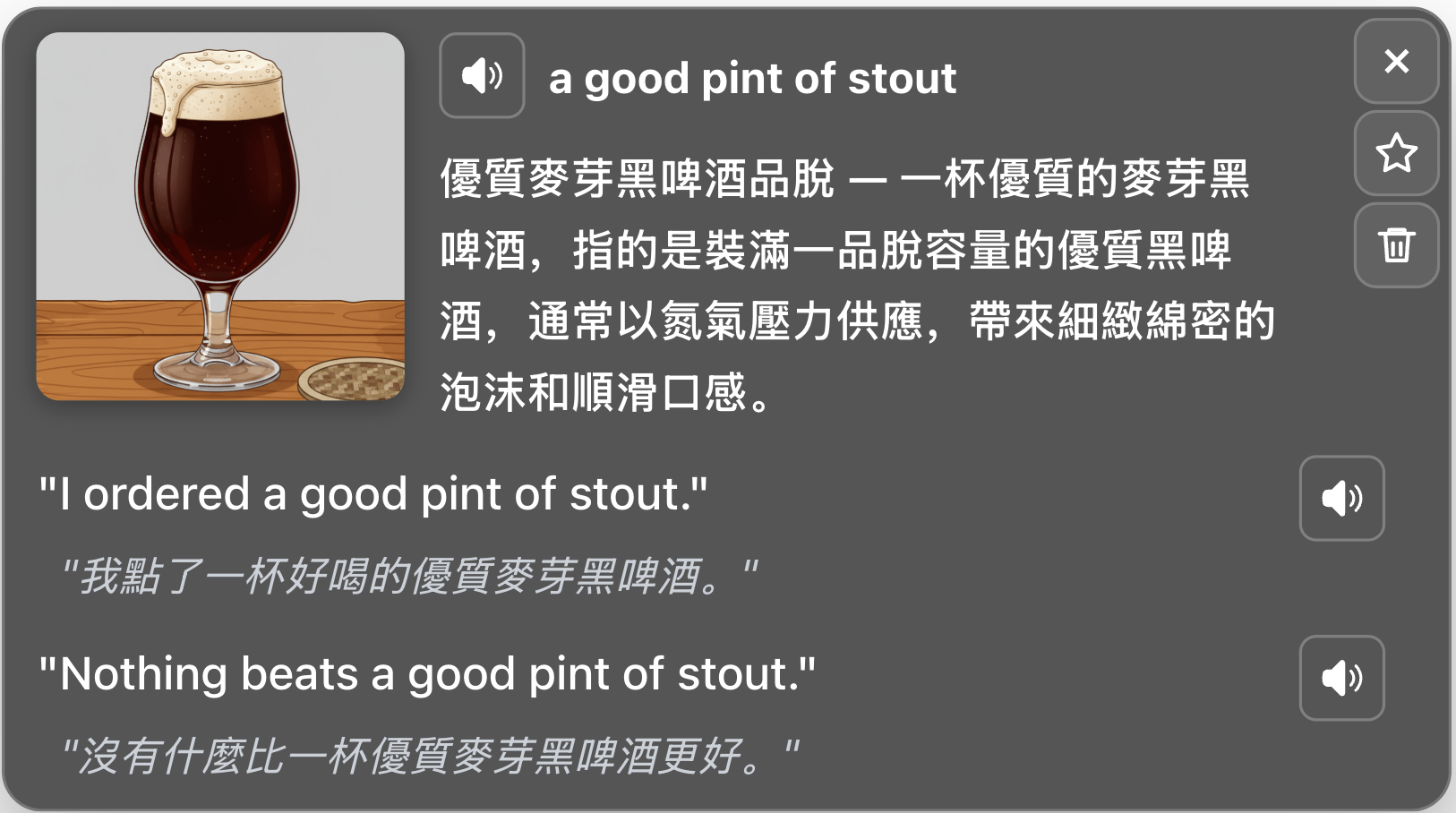
The advantage of automated visual aids is that you don't have to break your reading flow. The image just appears when you look up the word, and your brain forms the text-image association without any extra work.
Combining visual aids with other techniques
Visual + spaced repetition is the most powerful combination. You see the word-image pair at increasing intervals, reinforcing both memory traces. Visual + context adds a third anchor — the sentence you first encountered the word in. Visual + production (using the word in your own sentence while picturing the image) creates the strongest trace of all.
The bottom line
If you're learning vocabulary with text definitions alone, you're leaving a lot of retention on the table. Adding visual aids — whether you draw them, search for them, or use a tool that provides them — can roughly double your recall. The science has been clear for decades. The challenge was always making it easy enough that people actually do it. Your brain is wired to remember images. Might as well put that wiring to work.